

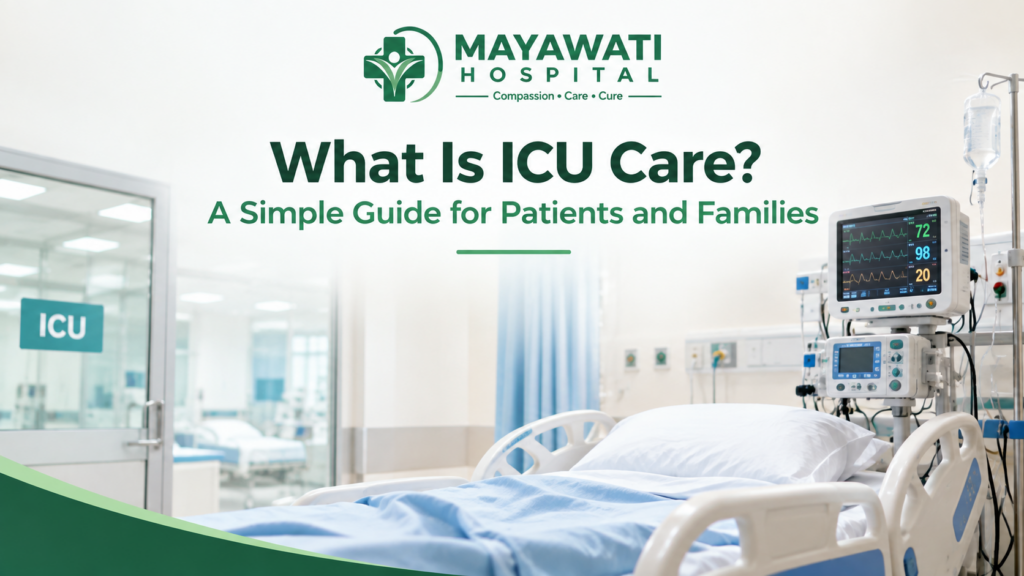
What Is ICU Care? A Simple Guide for Patients and Families
There’s a particular kind of fear that hits when a doctor says, “we’re shifting the patient to the ICU.” Suddenly you’re standing outside a room full of beeping machines, tubes, and monitors, not allowed to go in whenever you want, and nobody’s really explaining what’s happening. You just wait. And when you’re that scared, waiting without understanding anything makes it so much worse.
So let’s slow down and actually talk about what ICU care means — not in complicated medical language, but the way you’d want a friend to explain it to you. And along the way, I’ll also touch on why having a proper ICU Hospital in Ateli Mandi close to home genuinely matters, especially in those first critical hours.
What’s actually going on in there?
What Is ICU Care? A Simple Guide for Patients and Families
ICU stands for Intensive Care Unit, but honestly, the name doesn’t tell you much. Here’s the simplest way to think about it — in a regular hospital ward, nurses check on patients every few hours, and the doctor visits once or twice a day. That’s fine for most situations. But some patients need much closer attention than that, because their condition can shift quickly, sometimes within minutes. That’s what the ICU is built for.
In there, vitals like heart rate, oxygen levels, blood pressure, and breathing are being tracked almost continuously. If something even slightly starts going wrong, the team knows immediately — not two hours later during the next round. That’s really the whole point of it.
Why would someone end up in the ICU?
There isn’t just one reason, and honestly, it doesn’t always mean the worst has happened. Some common situations are:
Recovery right after a major surgery, when the body needs to be watched closely in those first few hours. Severe infections, where things can escalate fast if not caught early. Heart attacks, or any serious cardiac event. Major accidents or trauma. Breathing troubles that need ventilator support. Stroke, especially those first critical hours where quick action really matters.
If someone in your family has been moved there, it usually just means the doctors want to take absolutely no chances — not that things have already gone badly. That distinction matters, and it’s okay to ask the doctor directly which one it is for your situation.
About all that scary-looking equipment
The machines around an ICU bed do look intimidating the first time you see them, but each one is doing something fairly straightforward. A cardiac monitor keeps track of the heartbeat. A pulse oximeter checks oxygen levels in the blood. A ventilator helps with breathing when the patient can’t manage that on their own for a while. IV lines deliver fluids or medicine quickly and directly. Feeding tubes come in when a patient isn’t able to eat normally for a bit.
None of this equipment is there to scare you — it’s actually there so nothing gets missed, even the small stuff.
Why you’re not allowed inside all the time
This is honestly one of the hardest parts for families — being kept out, sometimes for hours. But there’s real reasoning behind it. ICU patients are far more prone to infections, so limiting the number of people going in and out genuinely protects them. It also lets the medical team focus without constant interruptions during moments when even small delays can matter.
Most ICUs still allow short visiting windows, and the nursing staff will usually update you if you ask. Don’t hesitate to ask questions either — a decent ICU team expects that from worried families, and you’re not bothering them by wanting clarity.
Why having one nearby actually changes outcomes
Here’s something that becomes painfully real in an emergency — time is often the single biggest factor between a good outcome and a bad one. A heart attack, a bad accident, sudden breathing failure — in all of these, the sooner proper ICU care starts, the better the chances genuinely are.
This is really why having a dependable ICU Hospital in Ateli Mandi matters so much for people here. In a real emergency, travelling far to reach a bigger city can eat up time a patient simply doesn’t have to spare. Having trained ICU care nearby means faster stabilisation, closer monitoring from the very first hour, and family close by during what’s already one of the hardest moments someone can go through.
A few things that genuinely help while you wait
Ask the doctor to explain updates in plain language — you’re completely within your right to ask that. Keep a small notebook for updates and questions, because stress makes people forget things fast. Take turns with other family members so no one burns out trying to be there every single hour. And try to trust the process, even when it feels painfully slow — constant monitoring usually means small problems are being caught and fixed quietly, before they turn into big ones.
In the end
ICU care feels frightening mostly because it’s unfamiliar, not because something is automatically wrong. At its heart, it exists for one simple reason — to give critically ill patients the closest, most immediate attention possible when they need it most. Understanding a little about what’s actually happening behind those doors can make an unbearably stressful time slightly more bearable.
And when every minute genuinely counts, having a trusted ICU Hospital in Ateli Mandi close by isn’t just convenient — it can be the difference that actually matters.
If you or someone in your family is going through a medical emergency right now, please don’t rely on an article for guidance — reach out to your doctor or the nearest hospital immediately.